Draw the system. Get staff-level feedback in 30 seconds.
You don't learn system design by watching.
Courses and videos feel productive. Then someone hands you a blank whiteboard and asks you to design WhatsApp.
Your only feedback loop is the interview itself
At top tech companies, only 20-25% of candidates pass technical interviews, and 41% of those rejected never find out what went wrong. Most engineers discover they weren't ready by failing, with a real offer on the line.
Watching is not practicing
Algorithms have LeetCode: thousands of reps with an instant verdict. System design has courses you watch and books you read. Nodding along with someone else's architecture is not the same skill as drawing one yourself.
The blank canvas freezes everyone
"Design Instagram" with 40 minutes and no starting point is paralyzing, so most engineers simply never practice. The first time you draw a system end to end shouldn't be in front of an interviewer.
Practice needs a feedback loop.
Draw. Get scored. Learn. Repeat.
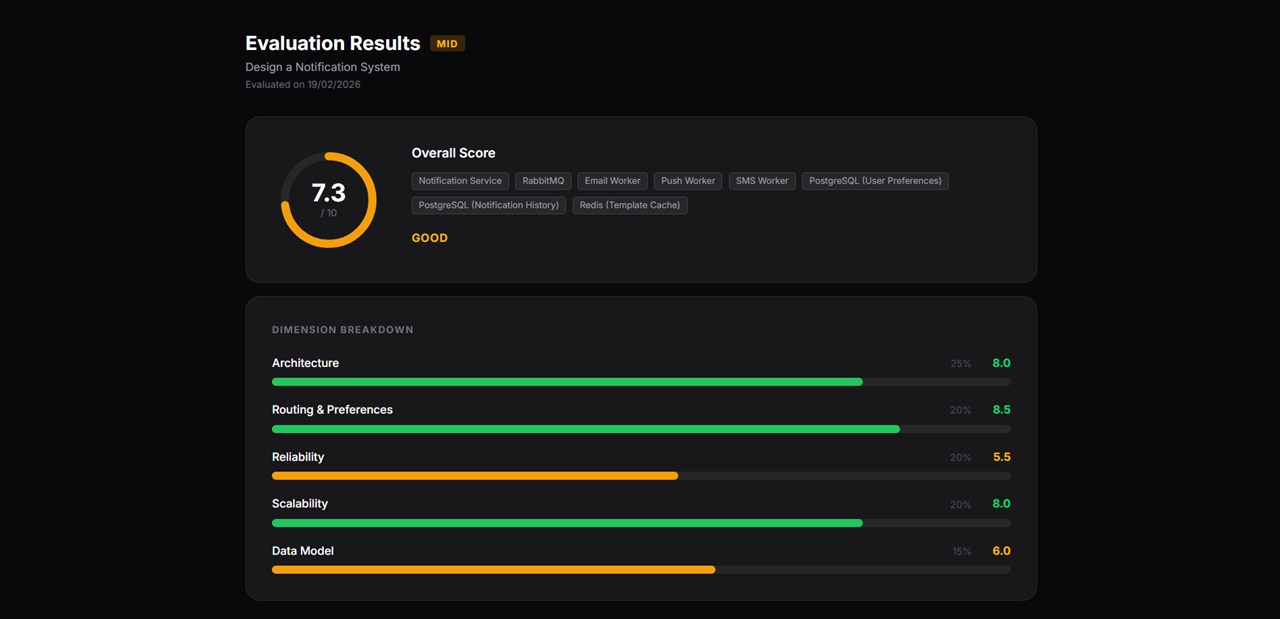
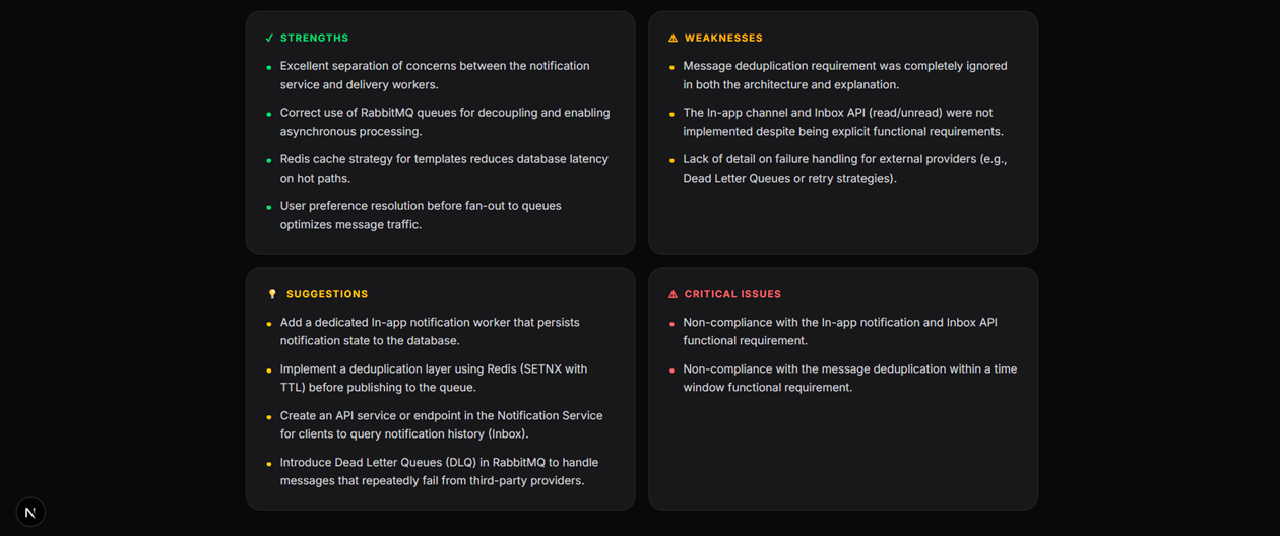
Pick a challenge, draw the architecture, and in about 30 seconds get the review a staff engineer would give you: a score for each dimension, the bottlenecks and single points of failure you missed, and concrete suggestions. Every evaluation tells you what to study next, so the next attempt is measurably better.
Feedback that names the problem
Not a generic checklist. The AI reads your actual diagram and your written reasoning, then points at the missing queue, the overloaded database, the cache that should be there.
5-minute micros, zero blank canvas
Micro-challenges drill one concept at a time: cache-aside, async queues, failover. Most start from a scaffolded diagram, so you change what matters and submit in minutes.
Progress you can see
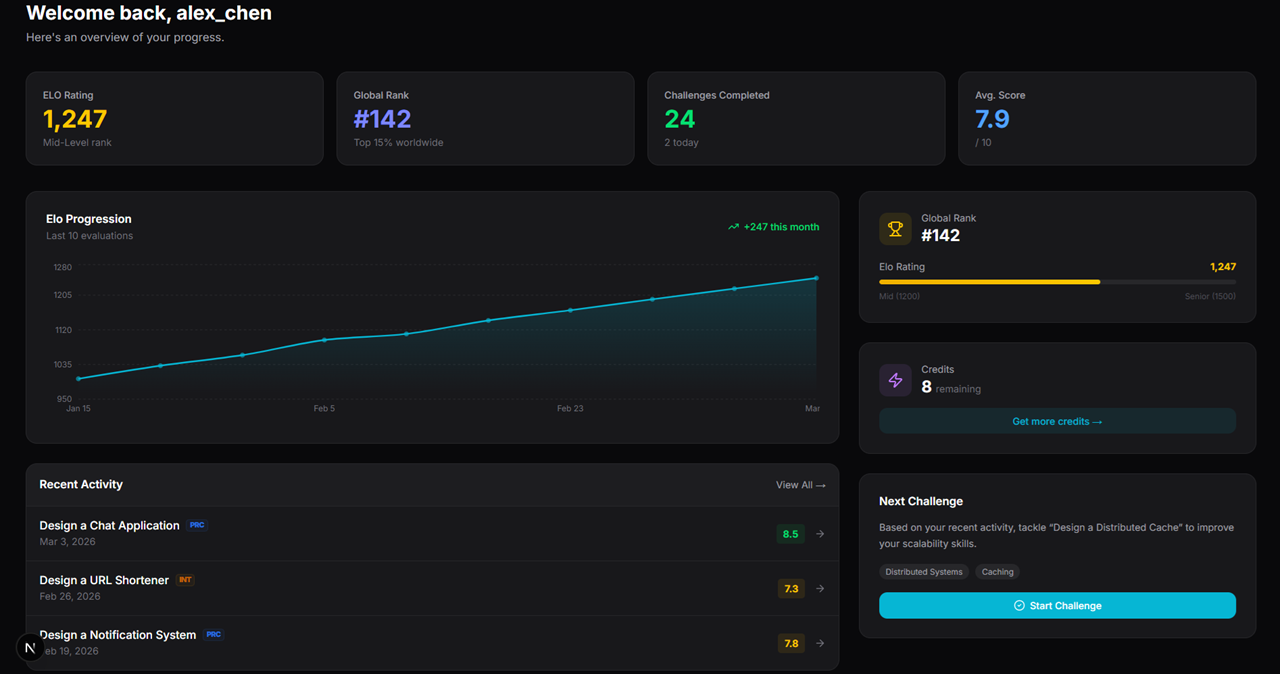
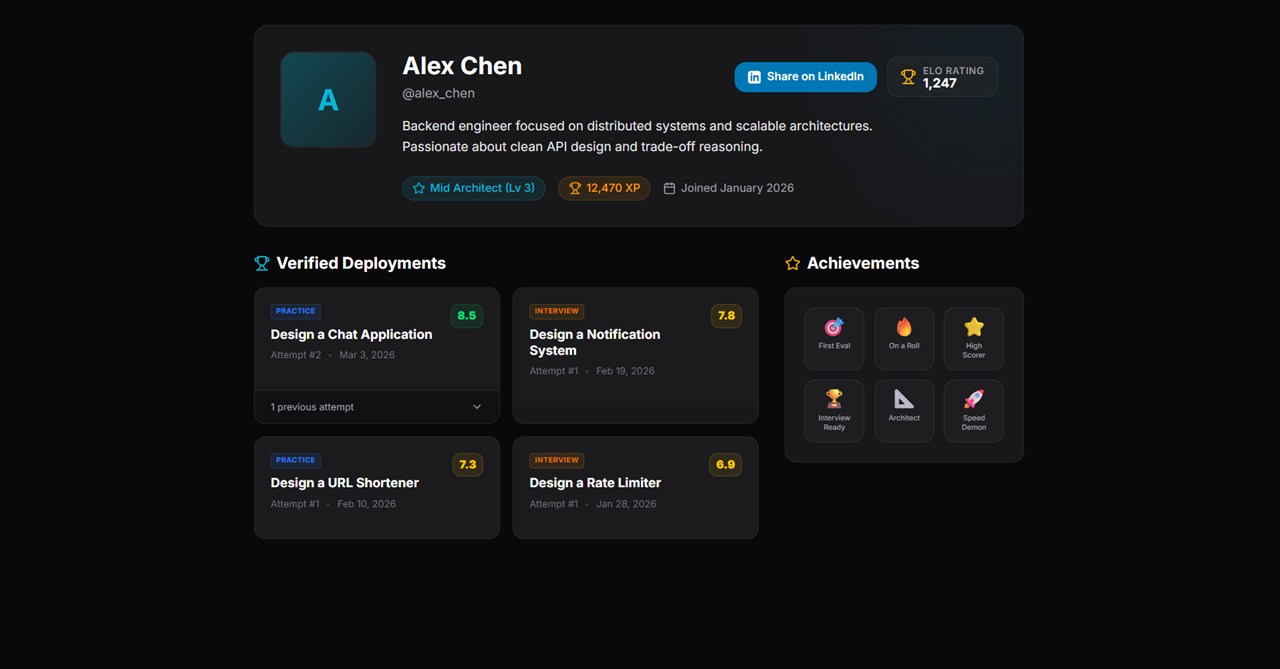
Dimension scores show your weak spots shrinking over time. Your best solutions build a public portfolio, and when you feel ready, timed interview simulation and an Elo rating are the final exam.
A ladder, not a leap
Micro-challenges build the muscle. Full challenges prove it. Every rung gives you a score and a next step.
Start at your level
Warm up with 5-minute micro-challenges that drill one concept each, or jump straight into full real-world scenarios like payment systems and social feeds. Every challenge states its requirements, constraints, and scale targets up front, so you always know what you're designing for.
Design on the infinite canvas
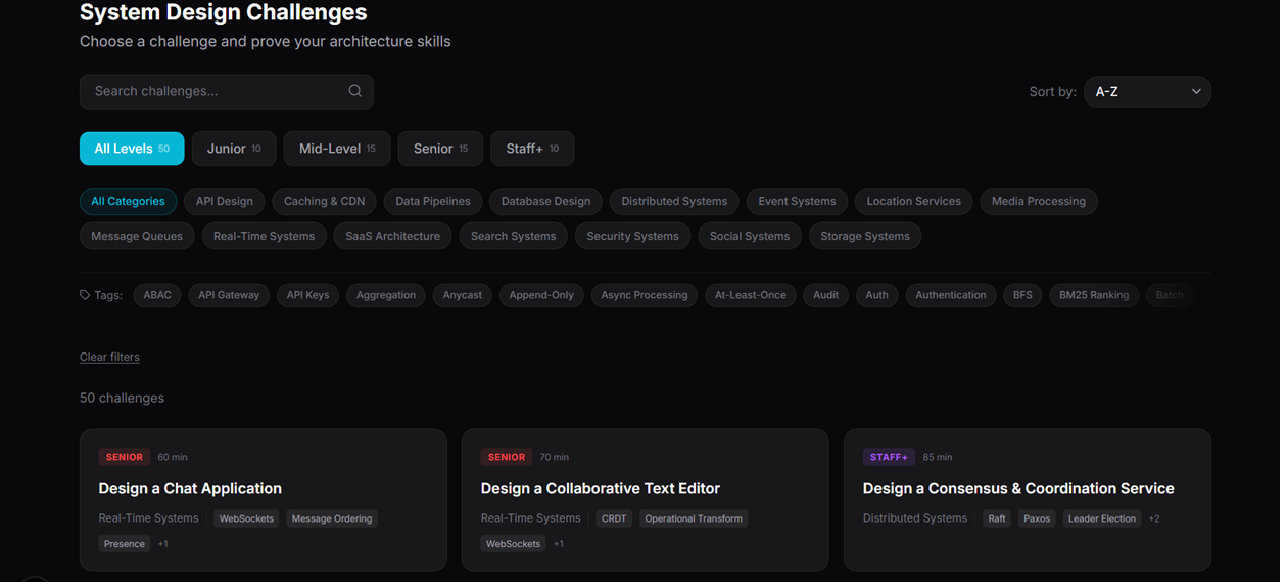
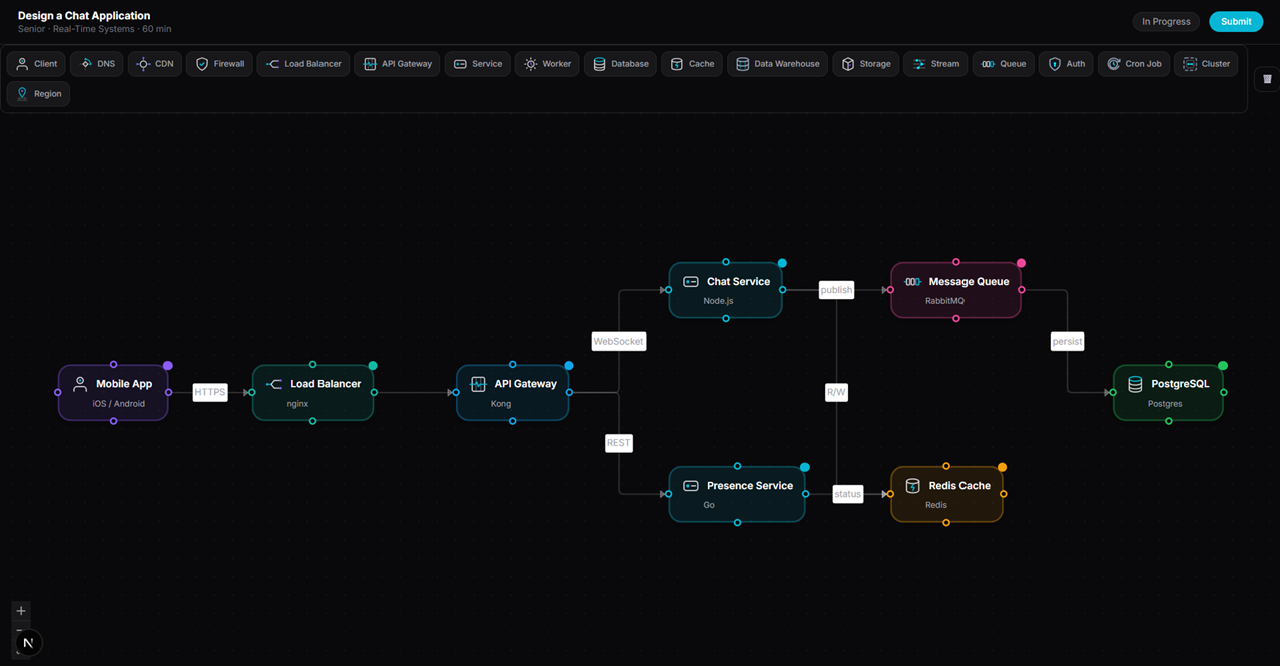
Drag-and-drop infrastructure components: services, databases, caches, queues, CDNs, load balancers. Draw connections, label protocols, and explain your reasoning in a written note. Micro-challenges start from a scaffolded diagram, never a blank page.
Get your review in 30 seconds
The AI scores your design across the dimensions that matter for that challenge: scalability, reliability, security, trade-offs. You see specific bottlenecks, missing components, and exactly what to study next, not a pass/fail stamp.
Climb the ladder
Weak dimension? There's a micro for it. On a streak? Take on a harder challenge. And when you're ready to prove it, timed interview simulation puts an Elo rating on your skill and your best solutions become a public portfolio.
Built around the feedback loop
Three things Archlify does that no other platform does.
Deep evaluations, not checklists
The AI doesn't just check if you added a cache. It analyzes your full architecture and written reasoning across scalability, reliability, security, and trade-off awareness, then gives specific, actionable feedback on every decision you made.
Micro-challenges: one concept, five minutes
The only platform with micro-drills for architecture. Each micro isolates a single concept, from cache-aside to failover, and most start from a scaffolded diagram you improve instead of a blank page you stare at.
Elo rating and a verified portfolio
When you're ready, blind timed interview simulation puts a competitive Elo rating on your skill, the same system that ranks chess grandmasters. Your highest-scoring solutions become a public portfolio no resume line can match.
Start free. Upgrade when you're ready.
1 credit = 1 AI evaluation. Your first 2 are free.
Credit-based, not a subscription. Buy once, use at your own pace, credits never expire.
Free to start · 2 evaluations included
Sign up and get 2 AI evaluations, enough for a micro-challenge and a full challenge. No payment info needed.
Starter
$0.99 per evaluation
10 evaluations
- 10 AI-powered evaluations
- Full dimension breakdown
- Elo rating updates
- Portfolio contributions
- Credits never expire — use at your own pace
Pro
$0.60 per evaluation
50 evaluations
- 50 AI-powered evaluations
- Full dimension breakdown
- Elo rating updates
- Portfolio contributions
- Full interview cycle coverage
- Credits never expire — use at your own pace
Expert
$0.50 per evaluation
100 evaluations
- 100 AI-powered evaluations
- Full dimension breakdown
- Elo rating updates
- Portfolio contributions
- Multiple interview cycles
- Credits never expire — use at your own pace
Payments processed securely via Paddle & Stripe.
Questions, answered
Everything you need to know before you start.
Micro-challenges are focused drills around a single concept: cache-aside, async queues, database failover, and more. Most start from a scaffolded diagram, so you never face a blank canvas. You make the changes that matter, submit, and get the same dimension-scored AI review as a full challenge, in about 5 minutes.
When you submit a solution, our AI analyzes your architecture diagram and written explanation across multiple dimensions: scalability, reliability, security, performance, and trade-off awareness. It identifies specific bottlenecks, single points of failure, missing components, and architectural anti-patterns, then provides actionable suggestions. The entire process typically takes 10–30 seconds.
Yes. Every new account receives 2 evaluation credits at no cost, no credit card required. You can explore the full challenge library, build on the canvas, and submit two complete solutions before spending anything. After that, you can purchase credit packs whenever you need them. There are no subscriptions, no automatic renewals, and no recurring charges — ever.
Elo is a mathematical rating system originally designed to rank chess players. In Archlify, every AI evaluation affects your Elo score based on your performance and the difficulty of the challenge. High scores on harder challenges earn more Elo points. This gives you a single, meaningful number that reflects your true architectural ability, not just how many challenges you've attempted.
Practice Mode lets you browse the full challenge library, costs 1 credit, and is untimed. It earns XP but doesn't affect your Elo rating, ideal for learning. Interview Mode uses a blind roulette: you select a difficulty, spin, and receive a random challenge you've never seen. It costs 2 credits (charged at spin time), includes a countdown timer, and your first attempt impacts your Elo rating. It also features an AI-generated Q&A defense phase.
No. Credits you purchase never expire. Buy at your own pace and use them whenever you're ready, whether that's in a focused practice week or spread across months.
Archlify is built for software engineers at any level who want to get serious about system design: whether you're preparing for upcoming FAANG-style interviews, working toward a senior or staff promotion, or simply want a portfolio that verifiably proves your architectural ability. It's also used by hiring teams and engineering leads who want an objective way to assess candidates.
Interview Simulation offers timed challenges where you don't choose the topic. A roulette draws a random challenge, and you only see the title before starting. Requirements are revealed when the timer begins. This prevents gaming the system by practicing a challenge first, making the Elo score a true measure of your ability. Credits are charged at spin time, so there's no backing out.
Stop guessing
what to study.
Your first review is 5 minutes away: draw a micro-challenge, get a scored breakdown, know your next step. 2 free evaluations, no credit card.
No credit card · 2 free evaluations · First rep in 5 minutes